About a month ago (this took time to write up), the Canadian federal government and the Alberta provincial government have unveiled a proposal to advance a new West Coast oil pipeline as part of a broader strategy to expand Canada’s energy exports beyond the U.S. Based on the proposed route (from Bruderheim to Delta), it’s expected to primarily carry crude produced from from oil sands (along with some conventional Western Canadian crude). So let’s talk about oil sands! We’ll first get a bit technical on extraction to understand what’s involved which will give us context to better discuss economic and environmental considerations.
This is a subject that interests me within a field that I know a bit about. My first big engineering internship was supposed to take me to the shores of the North Sea, where I would work on industrial natural gas dehydration systems involving liquid glycols. My future boss was a leader in gas process technology, and she seemed brilliant. I was absolutely thrilled. Then the pandemic struck. Between calls with the law firm, which was handling my visa, I learned that international internships had been cancelled.
A year later, I received an offer to do enhanced oil recovery work in the Ecuadorian jungle (mostly artificial lift stuff in the heavy oil fields of the Amazon basin). It was not meant to be at that time in my life. In 2022, I ended up working on an R&D project proposed to PetroEcuador involving plasma reactors and some gas cleaning technologies (the latter of which was the bulk of my contribution). I’ve always maintained an interest for O&G that ranged from technical matters to the geopolitical and economic considerations associated with black gold.
Canada’s proposed West Coast pipeline is ultimately a bet on the future of the oil sands. It’s drawing mixed reactions and very real and reasonable criticism in a world already facing impacts from climate change, where it seems electrification is underway and the push for alternatives to fossil fuels, where possible, is accelerating. Before talking about why the Canadian government might be leaning into such a project and whether that’s a good idea, it’s worth understanding what oil sands actually are and why they’re different from conventional crude.
This note will mostly discuss oil sands or tar sands (these mean the same thing). After a cursory review of what they are, how they are formed, and how they are extracted, there will be a discussion of costs and impacts, and that should help pose an informed perspective on the recently proposed project by the Carney government. It is lengthy and assembled in parts, but I figured I’d post it as one longer editorial piece.
PART 1 - Oil Sands: A Different Kind of Petroleum Resource
Oil sand deposits exist in more than 70 countries around the world, but three-quarters of them are concentrated in just two places: Venezuela, with 1.8 trillion barrels, and Canada, mostly in Northern Alberta, with 1.7 trillion barrels. Worldwide, oil sand resources are roughly three times the size of known global conventional petroleum reserves.
Canadian oil sands have been in production since 1967. The first “mine” (as this resource was first extracted much more with mining than the image you probably have of oil extraction involving rigs or pumpjacks) was a 30,000 barrel per day operation. Exploitation expanded with a second mine in 1978, operated by Syncrude, and Shell Canada joined the effort in 2003.
In Canada, oil sands underlie more than 140 000 square kilometres of Alberta, spread across three distinct regions: Athabasca, Cold Lake, and the Peace River geological areas.
Formation and Composition
Oil sands are crude deposits that are heavier and more viscous than other crude oils (conventional oil). They originate from crude oil that migrated towards, or even onto, the earth’s surface. Exposure to air, water, bacteria, heat, and pressure stripped the lighter components (the shorter chain hydrocarbons) from the mix, leaving heavy bitumen behind.
They consist of sand (of course), bitumen, clay minerals (including mica, rutile, zircon, tourmaline, and pyrite), and water. The heavy oil, or bitumen, occupies much of the pore space between the sand grains, which are surrounded by thin films of water.
 source: Carrigy, M.A., ed. Athabasca Oil Sands–The Karl A. Clark Volume.
Looking at the above depiction we note the main elements:
Fines – The water layer hosts very fine particles of clay, minerals, and other materials. These are contaminants to the bitumen and must be separated during extraction.
Water envelope – This surrounds each sand particle and is what enables us to separate the sand from the bitumen.
Sand particles – These are quartz and the aforementioned minerals, formed from the erosion of rocks.
Bitumen film – This is the hydrocarbon we are after, but to be usable in conventional refineries, the bitumen must first be separated from the oil sands and, depending on the operation, upgraded into a lighter synthetic crude.
Oil sand bulk composition is:
- 1 to 18 per cent bitumen (this may have changed with improvements in technology, but I was taught that anything below 6 per cent does not warrant commercial extraction)
- 3 to 5 per cent water
- 75 to 80 per cent sand (90 per cent of which is quartz)
Some gas can also be present in the void volume/dissolved in the mix.
Deposits are primarily classified by their depth as this informs what methods are appropriate for exploitation. In fact, oil sands extraction is broadly divided into two categories: surface mining and in-situ recovery. You can see some impressive photography of some open pit operations in Alberta in this Narwhal article
The extraction method used depends primarily on the depth of the deposit. Deposits close enough to the surface can be mined directly, while deeper deposits require techniques that recover the bitumen without removing the surrounding rock and sand. Over 80 per cent of Canada’s oil sands are too deep for mining and rely on in-situ technologies.
Within a given deposit, the bitumen can differ in quality with depth, with heavier, more coke-forming components tending to be more prevalent in some deeper portions of the formation. These heavier, non-volatile compounds, such as asphaltene and resins, will form solid petroleum coke under thermal treatment and will not become the oil that is the main commercial consideration.
Extracting Bitumen from the Ground Is the Main Difficulty
The fundamental challenge in oil sands extraction is the nature of bitumen itself, because, unlike conventional crude oil, bitumen is extremely dense and viscous, meaning it does not naturally flow through a reservoir. Whether through mining or in-situ methods, the ultimate goal is the same: separate this heavy hydrocarbon from the surrounding sand, water, and other materials so it can be transported and upgraded into usable crude oil.
This added complexity compared to conventional oil translates to higher costs, and in a globalised oil market, that translates to a reduced margin. That said, established operations (compared with a decade or two ago) are now debottlenecked, and with additional pipeline capacity such as the TMX project, they are now often considered among the lower-cost, long-life assets, despite their incredibly high capital requirements.
We can take West Texas Intermediate (WTI), the primary benchmark for oil pricing in the United States, as a reference, to get an idea of profitability at various price points with respect to revenue versus expense for oil sand exploitation :
| ~WTI $USD/bbl | Type of exploitation |
|---|---|
| 40-45 | This is just above break-even. The strongest existing mines and in-situ projects are still generally cash-flow positive at or slightly below this point. |
| ~50 | most existing operations continue producing, though profits shrink considerably below this point. There is little incentive to develop new sites due to very high upfront costs. |
| >60-70 | companies begin to view new greenfield mines and large expansions as economically attractive over the long term beyond this point. Below that, many projects struggle to generate acceptable returns on the billions of dollars of upfront investment |
PART 2 - How to extract this ressource
Surface Mining: Removing Oil Sand from the Surface
For surface/open-pit mining, the extraction process is relatively straightforward. First, the muskeg layer is removed, followed by the overburden above the oil sand deposit. Once the deposit is exposed, the oil sand is excavated using large shovels or excavators and transported by haul trucks to a processing or transport facility.
While the basic concept is simple, the scale of modern oil sands mining is extraordinary. Some surface operations use some of the largest machines ever built, including 360 ft draglines, 560 ft bucket-wheel excavators, and massive haul trucks powered by engines producing around 4,000 horsepower. These machines are engineering marvels in their own right and deserve attention beyond their role in oil sands extraction.
Surface mining is only practical where the deposit is close enough to the surface. The majority of remaining oil sands resources are too deep to economically mine, requiring a different approach: in-situ extraction.
In-Situ Extraction: Recovering Bitumen Underground
In-situ extraction involves recovering bitumen from deep underground without physically removing the oil sand deposit. Instead, operators must reduce the viscosity of the bitumen so it can move through the reservoir and be brought to the surface through production wells.
The most common approaches are thermal recovery methods, which use heat to soften the bitumen. Other methods rely on solvents, pressure changes, or combinations of techniques to improve the flow of heavy oil.
Thermal Recovery Methods
Steam-Assisted Gravity Drainage (SAGD)
Steam-Assisted Gravity Drainage (SAGD) is the dominant in-situ thermal recovery method used in the oil sands industry.
SAGD uses two parallel horizontal wells drilled through the reservoir, typically separated vertically by 4 to 6 metres. Steam is continuously injected into the upper well, heating the surrounding bitumen and reducing its viscosity. Once softened, the bitumen drains downward under gravity, assisted by steam pressure, into the lower production well where it is pumped to the surface.
SAGD is effective because it creates a large heated zone around the wells, allowing operators to recover significant volumes of bitumen while avoiding the need to remove the surrounding rock and sand.
Cyclic Steam Stimulation (CSS)
Cyclic Steam Stimulation (CSS), sometimes called the “huff and puff” method, uses a different approach. Instead of continuously injecting steam into one well while producing from another, CSS cycles between steam injection and production using the same well.
The process occurs in three stages:
- Steam injection: High-temperature steam is injected into the reservoir, heating and softening the bitumen.
- Soak period: The well is shut in, allowing heat to spread through the formation.
- Production: The softened bitumen flows back through the same well and is pumped to the surface.
CSS can be effective in certain reservoirs, particularly where SAGD is less suitable, although production can decline as repeated steam cycles become less efficient.
Solvent-Assisted Thermal Recovery
Both SAGD and CSS can be enhanced through the use of hydrocarbon solvents. Instead of relying solely on steam, operators can inject vaporised solvents such as propane or butane to dissolve and thin the bitumen.
Adding solvents can reduce the amount of steam required, lowering energy consumption and water use compared with purely steam-based extraction. This can improve efficiency and reduce some of the environmental impacts associated with thermal recovery.
Toe-to-Heel Air Injection (THAI)
A less widely adopted thermal method is Toe-to-Heel Air Injection (THAI). In this process, air is injected into the reservoir through a well at the “toe”, or the closed end, of a horizontal production well. The bitumen is then ignited (supported by injected air), creating a moving combustion front that travels through the reservoir towards the production well.
The heat generated by combustion reduces the viscosity of the bitumen, allowing lower-viscosity oil to move towards the production well. In addition, the heat can crack heavier hydrocarbons, partially upgrading the bitumen into a lower-density and lower-viscosity product before it reaches the surface.
In theory, THAI offers several advantages, but commercial implementation has proven challenging. Field tests, including the Petrobank Kerrobert project, encountered several technical problems. If the combustion front moves too quickly or unevenly, oxygen can reach the production well and cause combustion near the wellbore. This can damage expensive downhole equipment, including sand screens and production hardware.
High-pressure combustion gases can also create difficulties for surface processing equipment. Thermal cracking may generate petroleum coke, which can accumulate in the reservoir, block pore spaces, and restrict production.
These challenges are partly due to the complexity of underground formations. Reservoirs are rarely uniform, and variations such as water-rich zones or tight shale barriers can disrupt combustion movement. As a result, most major operators have focused primarily on SAGD and increasingly on solvent-assisted recovery methods.
Non-Thermal Recovery Methods
Thermal recovery methods like SAGD dominate commercial in-situ oil sands production, but they are not the only approaches available. A range of non-thermal methods have been developed to recover heavy oil and bitumen using pressure changes, solvents, or changes in reservoir flow behaviour rather than relying primarily on heat.
These methods are attractive because reducing steam requirements can lower energy consumption, water use, and greenhouse gas emissions. However, they introduce their own technical challenges, particularly around slow production rates, solvent recovery, and maintaining flow through the reservoir.
Among these approaches, Cold Heavy-Oil Production with Sand (CHOPS), VAPEX, and the N-Solv process are some of the most notable examples.
Cold Heavy-Oil Production with Sand (CHOPS)
Most in-situ recovery methods attempt to reduce bitumen viscosity before extraction. They use heat, solvents, or a combination of both to make the oil flow more easily while limiting the amount of sand produced with the bitumen.
CHOPS takes the opposite approach. Instead of trying to avoid the difficult properties of heavy oil, it embraces them by intentionally producing large quantities of reservoir sand along with the oil.
The process uses specialised pumps, typically progressive cavity pumps (PCPs), which are lowered into the well and designed to handle large volumes of sand and heavy oil. As material is removed from the reservoir, pressure changes create empty channels known as wormholes. These channels expand outward from the wellbore, creating pathways through which additional heavy oil can flow.
This process can dramatically increase production rates. Because the reservoir sand is actively mobilised rather than left in place, CHOPS wells can produce oil at rates an order of magnitude or more above comparable sand-excluding cold-production methods because progressive sand production creates highly permeable flow channels and expands the effective drainage region. Unlike thermal recovery, CHOPS does not depend on the slow propagation of a thermal front to reduce oil viscosity; consequently, production is not constrained by the associated heat-transfer timescales.
Another factor that improves flow is the behaviour of dissolved gas within the oil. As pressure drops around the well, gas dissolved in the heavy oil expands, creating a foamy oil structure with lower effective density and improved mobility. This helps move the oil through the developing wormhole network.
However, the advantages of CHOPS come with significant trade-offs. Producing large volumes of sand creates major surface handling and disposal challenges. The sand must eventually be separated from the oil and managed as a waste material requiring storage, treatment, or reclamation.
There are also limits to the longevity of the process. The so-called “wormholes” may collapse, intersect unwanted water-bearing zones, or fail to connect effectively through the reservoir. In some cases, more than 85% of the original oil may remain trapped underground after CHOPS production declines.
Because of this, CHOPS is often considered the first phase in a broader reservoir development strategy (well lifecycle). Its low cost makes it attractive for quickly extracting the easiest oil while creating an extensive network of underground flow pathways. Once CHOPS production declines, operators can attempt to recover some of the remaining bitumen using thermal stimulation, solvents, or other enhanced recovery methods.
Solvent-Based Recovery: VAPEX and N-Solv
VAPEX (Vapour Extraction Process) and N-Solv are both horizontal well, solvent-based technologies designed to recover heavy oil and bitumen without the large water and energy requirements associated with steam-based extraction.
Both methods use hydrocarbon solvents to reduce bitumen viscosity, but they differ in how the solvent interacts with the reservoir.
VAPEX: The Diffusion Problem
VAPEX relies on injecting a solvent vapour, typically near its dew point, into the reservoir. The solvent molecules gradually diffuse into the surrounding bitumen, reducing its viscosity and allowing the diluted oil to drain towards a production well.
The major advantage of VAPEX is its extremely low energy requirement. Unlike SAGD, it does not require large volumes of steam, and it can operate close to the natural reservoir temperature.
However, this strength is also its greatest weakness. Diffusion through cold, highly viscous bitumen is extremely slow. The solvent must gradually penetrate what is nearly a solid-like hydrocarbon material before production rates increase.
As a result, VAPEX wells can take months to several years to reach meaningful production rates, and the slow ramp-up has made commercial economics difficult. The underlying physics are sound, but the production rates have generally been too low to compete with established thermal methods.
Another challenge is asphaltene precipitation. When solvent contacts bitumen, heavy components called asphaltenes can separate from the oil and form solid deposits. Not only can these impede diffusion, they can block reservoir pores and restrict flow if occurring close to a production well.
N-Solv: Adding Heat to Improve Solvent Recovery
The N-Solv process builds on the concept behind VAPEX but introduces controlled amounts of heat by injecting solvent heated to typically around 50 °C to 60 °C.
This additional heat transfers to the bitumen, lowering its viscosity which in turn facilitates solvent mixing and diffusion and improving drainage rates. The method achieves production rates several times higher than ambient VAPEX while maintaining many of the environmental advantages of solvent-based recovery.
The improved flowability of bitumen with this method also lets asphaltenes (if any) deposit deeper within the depleted reservoir matrix, reducing plugging risks and helping maintain production.
It’s not perfect though and presents some challenges. The process requires maintaining higher pressures to keep the solvent in the desired vapour state. This increases the risk of solvent becoming trapped within the reservoir, known as solvent retention. Since solvents such as propane and butane are valuable materials, any unrecovered solvent represents both an environmental concern and a significant economic penalty at the scales involved.
No single extraction method is ideal. Each technology represents a compromise between production rate, energy use, water consumption, environmental impact, and economic viability. This is why commercial oil sands operations continue to rely primarily on SAGD while exploring solvent-based and hybrid recovery methods for future development.
PART 3 - From Bitumen to Crude Oil
What Comes Out of the Ground?
Although the goal of oil sands extraction is to recover bitumen, the material produced from the reservoir is far from a finished petroleum product. The composition of the recovered material depends largely on whether the resource is extracted through surface mining or in-situ methods, and this difference affects how the material is transported, processed, and prepared for upgrading or refining.
In surface mining, the initial product is the oil sand itself: a mixture of bitumen, sand, clay, water, and other minerals. Because large-scale mining equipment removes the entire oil-bearing deposit, the first stages of handling involve moving large volumes of material from the mine site to an extraction facility. This can be done using conveyor systems, haul trucks, or by mixing the oil sand with hot water to create a pumpable slurry.
This slurry transport method, known as hydrotransport, uses water and mechanical agitation to move the mined oil sand through pipelines to the processing facility. The turbulence created during transport helps break apart the mined material and can begin the separation process by liberating some of the bitumen from the surrounding sand grains before the material reaches the extraction plant.
In-situ recovery produces a different type of material because the entire oil sand deposit is not removed. Instead, production wells bring a mixture of bitumen, water, dissolved gases, and varying amounts of sand to the surface. Conventional in-situ operations, such as SAGD, are designed to minimise sand production. Downhole sand screens are installed around the production well to allow fluids to enter while preventing reservoir sand from entering the wellbore and damaging pumps and processing equipment.
Because in-situ operations produce fluids rather than raw oil sand (CHOPS being an uncommon exception), the recovered mixture is collected and transported through pipelines to central processing facilities. At these facilities, water, gases, carryover sand, and other impurities are removed before the bitumen is sent for upgrading or refining. Mined oil sands require more extensive physical separation processes to extract the bitumen from the large quantities of sand, clay, and water contained in the original deposit.
Regardless of the extraction method, the material is conveyed to specialised facilities for required processing. Although transport represents a relatively small part of the overall oil sands extraction process, it strongly influences the design and economics of operations. Moving large volumes of heavy material or highly viscous fluids requires significant infrastructure, energy, and maintenance, particularly because many oil sands deposits are located in remote areas. This is a good chunk of those high upfront costs of getting a new project set up and productive.
Separating the Bitumen
When the result of recovery is a complex mixture of bitumen, sand, clay, water, and other minerals, the bitumen must be separated before it can be transported for upgrading or refining. There is an extraction process which simply aims to recover as much bitumen as possible while separating it from the surrounding solids and water.
Hot Water Extraction
The dominant commercial method for recovering bitumen from mined oil sands is the Clark hot water extraction process, developed in the 1920s and refined through decades of industrial operation.
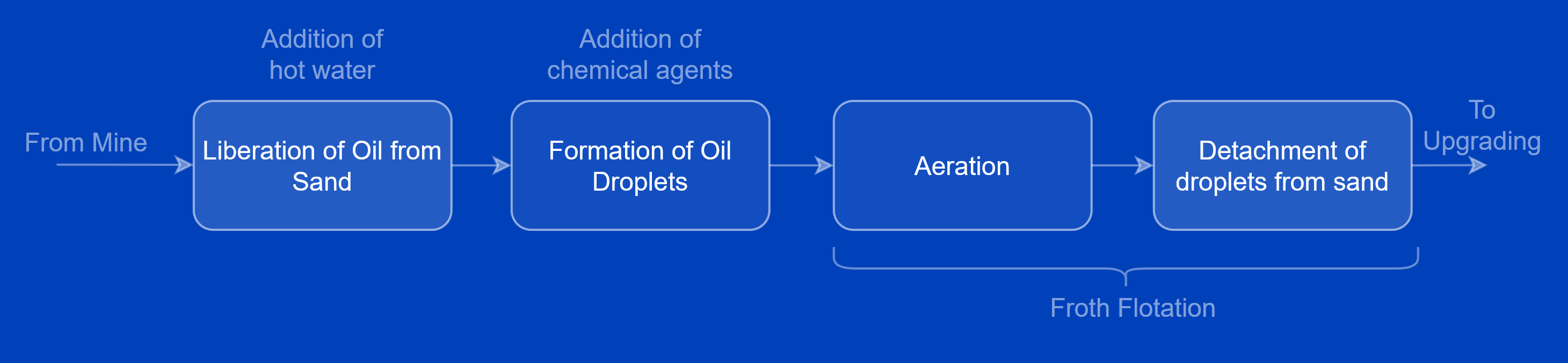
Mined oil sands are mixed with hot water to form a slurry, which is processed through large gravity separation units. During this stage, the bitumen separates from the sand and coarse mineral solids and is aerated, making it rise to the surface as a bitumen froth (air bubbles attached to the bitumen) because it is less dense than water. This primary separation concentrates a good amount of the bitumen which can be collected directly, but the froth layer still contains significant amounts of water, clay, and fine sand.
The bitumen froth is then treated with a light hydrocarbon solvent to reduce its viscosity and promote the removal of the remaining water and fine solids using gravity settlers or centrifuges. The resulting diluted bitumen is sufficiently clean for transport to upgrading or refining, where it is converted into synthetic crude oil or refined petroleum products.
Oil Sands Magazine has a great primer with neat visuals of the separator.
Tailings and Waste Management
One of the major challenges of mined oil sands extraction is managing the large volume of leftover material. The separation process removes the valuable bitumen fraction but leaves behind a mixture of water, sand, clay, and residual hydrocarbons known as tailings.
Coarse sand settles relatively quickly and can often be reused in reclamation activities. However, fine clay particles can remain suspended in water for years, creating large tailings ponds that require long-term management.
Alternative Solvent-Based Extraction
Reducing tailings volume and improving reclamation methods have become major areas of research within the industry. Technologies such as improved dewatering, centrifugation, and chemical treatment aim to accelerate the separation of water from fine solids and reduce the environmental footprint of tailings storage.
While hot water extraction remains the dominant commercial technology, solvent-based methods are being investigated as alternatives or supplements. Instead of relying primarily on heat and water to liberate bitumen from sand, solvents can dissolve and thin the bitumen directly.
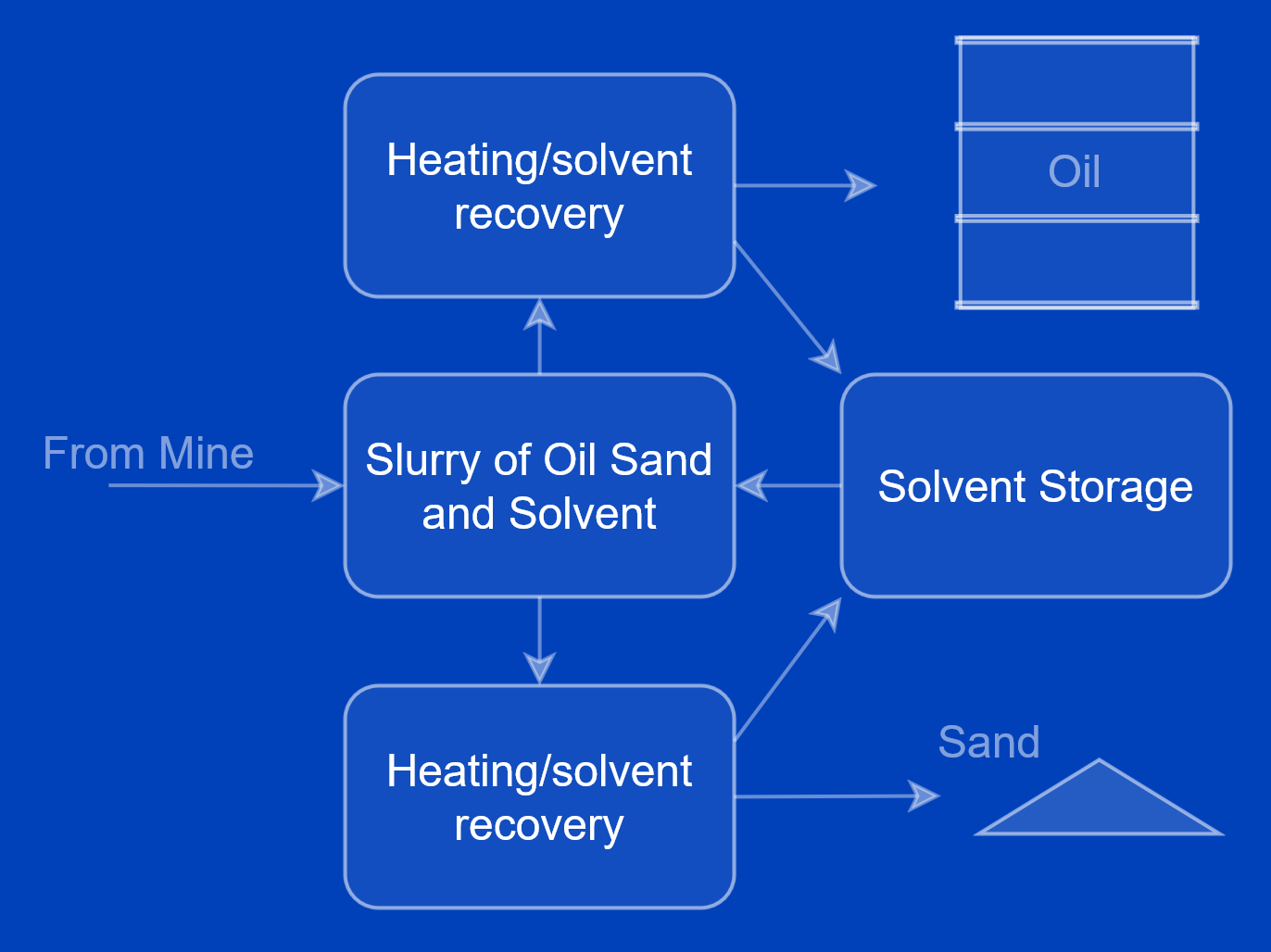
Fresh oil sand is mixed with recycled solvent up to a solvent-to-bitumen ratio of around 0.5 by weight. This is followed by a few stages of countercurrent wash, settling and draining. The collected sand and oil streams are treated to recover and recycle the solvent. I made a simplified depiction above.
These methods are attractive because they have the potential to reduce water use and improve performance with challenging oil sands deposits where conventional extraction is less effective. However, effective solvent recovery, cost, and process complexity remain significant challenges.
Each extraction method reflects a trade-off between efficiency, water use, cost, and environmental impact. The hot water process dominates today because of its proven scalability and decades of operational experience, but solvent-based approaches are becoming increasingly important as the industry looks for lower-water and lower-energy alternatives. You’ll notice the similarity in these methods to some of the processes used in-situ (using heat or solvents to recover the bitumen) and that is no surprise since it is the same base resource, the oil sands, in both conditions. What works to separate the bitument underground also works to isolate it from mined sand.
| Method | Temperature | Water Use | Key Process | Best For |
|---|---|---|---|---|
| Hot Water Process | 50–80°C (122–176°F) | Significant (requires 2–5 barrels per barrel of bitumen) | Hot water and caustic soda soften bitumen; mechanical agitation separates it from sand and clay; bitumen floats to top | Thicker ore deposits; most common commercially |
| Solvent Extraction | Moderate heat (varies) | Minimal | Uses organic solvents (toluene, naphtha, or proprietary blends) to directly dissolve bitumen from ore; solvent is recycled | Lower-quality ore; reducing water consumption; emerging processes |
Upgrading the Bitumen
Compared with conventional crude oil, bitumen is extremely heavy, highly viscous, and contains larger amounts of impurities such as sulphur, nitrogen, metals, and complex hydrocarbon molecules like the previously mentioned asphaltenes. To make it suitable for transportation and refining along with conventional crude, bitumen undergoes upgrading, where it is broken down and transformed into a lighter synthetic crude oil (SCO) and other petroleum products. The objective is to reduce viscosity, increase the proportion of lighter hydrocarbons, and remove contaminants that can interfere with downstream refining.
Thermal Conversion and Coking
One of the primary upgrading methods is thermal conversion, often carried out through a process called coking.
Coking uses high temperatures to break apart the heaviest hydrocarbon molecules in bitumen. Because bitumen contains a large fraction of heavy carbon-rich compounds, thermal cracking converts some of these large molecules into smaller, more valuable hydrocarbons such as gases, naphtha, and gas oils.
The remaining material is a carbon-rich solid: petroleum coke, and a significant by-product of bitumen upgrading. Most petroleum coke produced from Canadian oil sands upgrading is fuel-grade petcoke, which is sold as an industrial fuel for cement kilns, power generation, or gasification because its relatively high sulphur and metal content makes it unsuitable for higher-value applications such as aluminium anodes.
This aforementioned process is one of carbon rejection because it removes excess carbon from the original bitumen rather than adding hydrogen to the fuel molecules.
Note that for this and other processes, there are many various methods that this note is not delving into that can all result in petroleum coke (delayed coking, fluid coking, flexicoking, etc). Upgrading is the subject of many textbooks with many pathways and pros and cons and way beyond this introductory discussion.
Catalytic Conversion and Hydroprocessing
The second major approach involves using catalysts to improve the quality of the hydrocarbon molecules. Catalytic processes help break down heavier compounds and prepare them for further treatment.
A key part of this stage is hydrotreating, where the hydrocarbon streams are mixed with hydrogen at high pressure and temperature, typically around 300 to 400°C. The hydrogen reacts with unstable molecules, reducing their tendency to continue reacting and changing composition during transport and refining.
Hydrotreating also removes impurities, including:
- sulphur, which forms sulphur oxides during combustion and contributes to pollution
- nitrogen compounds, which can interfere with refinery processes
- trace metals that can damage catalysts and processing equipment
The addition of hydrogen also improves the stability and quality of the final product by converting unsaturated and unstable hydrocarbon structures into more stable molecules. It’s an upgrading scheme that doesn’t rely so heavily on coking (from carbon rejection).
Creating Synthetic Crude Oil
After upgrading, the various oil fractions produced are blended in appropriate proportions into a synthetic crude oil product. Compared with the original bitumen, synthetic crude is lighter, much less viscous, and contains fewer contaminants, making it easier to transport and possible to process in conventional refineries.
The exact final composition depends on the upgrading process and the original bitumen characteristics, but the final product is designed to resemble a conventional crude oil as a blend of hydrocarbon fractions with similar refinery product yield distribution.
Once upgraded and prepared, the synthetic crude can be transported to refineries where it is processed into fuels and other petroleum products, including petrol, diesel, jet fuel, heating oil, and chemical precursors (plastics, textiles, drugs).
The upgrading stage (along with transportation given large distances involved) represents a major energy and economic trade-off in oil sands production. It increases the value and usability of bitumen, but it also requires significant energy and processing infrastructure that does not burden conventional oil.
PART 4 - The Costs Not on Spreadsheets
Environmental Impacts and Trade-offs
Oil sands development is one of the more technically challenging forms of petroleum production. The same characteristics that make bitumen abundant also make it difficult to extract: it is heavy, immobile, and requires significant energy and processing before it becomes a usable crude oil product.
These additional steps create environmental impacts beyond those associated with many conventional oil projects. The major areas of concern are greenhouse gas emissions, land disturbance, water use, tailings management, and the risks associated with transporting large volumes of petroleum products.
Development of oil sands represents a series of competing priorities: energy security, economic development, environmental protection, and climate goals.
Technological improvements have reduced the impact of oil sands operations compared with earlier projects, but the scale of development means that even incremental impacts remain significant. The environmental discussion around oil sands is therefore not only about whether impacts exist, but also about how those impacts are managed, who bears the risks, and who participates in decisions about land, water, and long-term stewardship.
These questions become especially important in the context of Indigenous communities, whose traditional territories overlap with many oil sands developments and who increasingly play roles in environmental monitoring, ownership, and resource governance.
Greenhouse Gas Emissions: The Carbon Intensity Problem
One of the most significant criticisms of oil sands production is its greenhouse gas intensity. Compared with conventional oil extraction, oil sands production generally produces more emissions per barrel because additional energy is required to mine, separate, heat, and upgrade the bitumen.
The difference is especially significant for in-situ production. Methods such as SAGD require large quantities of steam to heat underground bitumen and make it mobile. Generating this steam typically requires burning natural gas, adding to the overall emissions profile of the extracted oil.
Oil sands production has also grown significantly over the past several decades, meaning that even improvements in emissions intensity have occurred alongside a major increase in total production.
Quoting from Environment and Climate Change Canada here:

Between 1990 and 2024, total crude oil production more than doubled in Canada. This was mostly driven by a rapid increase in production from the oil sands, which are more GHG-intensive than conventional sources (that is, more GHGs are emitted per unit cubic meters of oil produced). This change thus had a major impact on total GHG emissions from the sector.
From 1990 to 2024, GHG emissions from conventional oil production have increased by 4%, while emissions from oil sands production have increased by 529%. More than half of the increase in emissions from oil sands production over this period came from the growth of in situ production. Over the same period, GHG emissions related to the production of natural gas also increased significantly (+36%), mainly driven by the production growth.
From 2005 to 2024, emissions from the oil and gas sector increased by 5%. However, emissions from natural gas and conventional oil production decreased by 31% and 37%, respectively. Emissions from those activities have shown decreasing trends in the past decade.
The key point from the data is that the growth of oil sands production has been a major driver of increasing emissions from the Canadian oil and gas sector. Much of this growth has come from in-situ operations, which have expanded rapidly because they allow access to deposits too deep for surface mining.
The industry has attempted to reduce emissions through improved steam efficiency, solvent-assisted extraction, electrification, methane reduction, and carbon capture and storage projects. However, the fundamental challenge remains that extracting a resource as heavy as bitumen requires more energy than producing lighter conventional crude oils.
Land Disturbance and the Boreal Forest
Surface mining creates the most visible physical footprint of oil sands development. Before mining can begin, muskeg, vegetation, and overlying soil must be removed to expose the oil-bearing deposit below.
The mining region lies within the Canadian boreal forest, one of the largest remaining wilderness ecosystems on Earth. The boreal forest contains approximately 35% of the world’s wetlands, supports thousands of plant and animal species, stores significant amounts of carbon, and plays an important role in water filtration and climate regulation.
Because of this, the impact of mining is not simply the removal of trees. The disturbance affects an entire ecosystem, including wetlands, wildlife habitat, soil structure, and carbon storage.
Oil sands operators have legal obligations to reclaim mined land. In general, reclamation involves using mine waste materials to reshape the landscape, replacing stored topsoil, and planting native vegetation including grasses, shrubs, and trees with the goal of restoring boreal forest or grassland ecosystems.
However, reclamation is a very slow process. The first commercial oil sands mine began operation in 1967, yet restoring a complex boreal ecosystem takes decades.
Since operations began, millions of trees have been planted as part of reclamation efforts. However, the amount of land formally recognised as reclaimed remains small compared with the total disturbed area. The first formal reclamation certificate for an oil sands operation was only issued by the Alberta government in 2008. There’s been more certification since, but at the time of writing, this corresponds to around 0.1% of the disturbed land area for oil sands.
It is important to distinguish between revegetation and ecological reclamation. Planting trees and grasses is one step, but recreating the original ecosystem, including wetlands, soil communities, and biodiversity, is a much more complex process and a slower process.
Industry argues that reclaimed landscapes can eventually support ecosystems similar to the original boreal forest. Critics argue that restoring an ecosystem that developed over thousands of years cannot be measured simply by the number of trees planted or the return of surface vegetation.
Tailings Ponds: A Long-Term Challenge
One of the most difficult environmental challenges associated with mined oil sands is tailings management.
After bitumen is separated from mined oil sand, the remaining material consists of water, sand, clay, and residual hydrocarbons. This mixture is stored in large containment areas known as tailings ponds.
Coarse sand settles relatively quickly and can be incorporated into reclamation activities. However, fine clay particles can remain suspended for years, creating a mixture that is difficult to dewater and stabilise.
Unlike mined land, where vegetation can eventually be replanted, tailings ponds present a much more complex reclamation problem. Issues include long-term water quality, fine sediment stability, and ensuring that reclaimed landscapes are safe and functional ecosystems.
To date, no large oil sands tailings pond has received full reclamation certification. Although companies have developed technologies to accelerate tailings treatment and reduce storage times, a fully demonstrated solution at the scale required remains an ongoing challenge.
Water Use
Oil sands operations require water for different purposes depending on the extraction method. Mining operations use water to separate bitumen from sand and clay, while in-situ operations use water to generate steam. Water use is another major environmental consideration.
Depending on the project and extraction method, producing one barrel of oil sands crude can require several barrels of water, although much of the water used in modern operations is recycled which is a significant improvement.
Oil sands operators are licensed to divert more than 350 million cubic metres of water per year from the Athabasca River system, an amount comparable to roughly twice the annual water consumption of the city of Calgary.
A major concern is that, while much of the process water is recycled, a significant fraction ultimately becomes trapped in tailings ponds rather than returning immediately to the natural water cycle.
Water management is therefore a long-term issue: not only how much water is withdrawn, but how quickly it can be safely returned to the environment.
Pipelines, Spills, and Environmental Liability
The environmental impacts of oil sands development do not end at the production site. Once extracted and upgraded, petroleum products must be transported, often through large pipeline networks.
The Keystone pipeline provides an example of the broader debate around pipeline risk and regulation. When TransCanada, now TC Energy, applied for approval for Keystone, its risk assessment predicted approximately one spill every seven years. At the time of writing, the pipeline has operated for approximately 16 years and experienced 28 reported spills, releasing a rough total 29,000 barrels of crude oil. 22 of these incidents released fewer than 50 barrels of oil and were within operator-controlled property (e.g. pump station).
The largest Keystone spill occurred in Kansas in 2022, releasing approximately half of that total volume into a local creek. In an amended corrective action order (ACOA) to the operator, TC Energy, the Pipeline and Hazardous Materials Safety Administration (PHMSA) highlighted a “pattern in recent years of increasingly frequent incidents resulting in larger releases,” following the Kansas incident.
The incident’s settlement included approximately:
- $27 million in federal civil penalties
- $3 million allocated to Kansas resource restoration
- $40 million for required safety upgrades
The direct cleanup cost was approximately $480 million.
This difference between regulatory penalties and cleanup costs highlights a major debate in environmental regulation: whether fines provide enough incentive for prevention, or whether companies simply treat penalties as a predictable cost of operation.
Fines, Liability, and the Cost of Prevention
In both Canada and the United States, environmental penalties are generally based on statutory frameworks rather than a direct percentage of company size or total environmental damage.
In the United States, civil penalties under laws such as the Clean Water Act and pipeline regulations are limited by statutory caps. The result is that even a very large spill may not produce a fine proportional to the cleanup cost.
The argument from regulators is that the main financial deterrent is not the fine itself, but the requirement that operators pay for emergency response, remediation, and infrastructure improvements.
Critics argue that when penalties are relatively small compared with the revenues of large energy companies, they risk becoming viewed as a cost of doing business rather than a strong preventative incentive.
Canada follows a similar approach but differs in an important way through its absolute liability framework for major pipelines.
Under this system, operators of large pipelines can be held financially responsible for cleanup and damages up to a set threshold even without proof of negligence. For major pipelines carrying more than 250,000 barrels per day, that threshold can reach $1 billion. If negligence or fault is proven, liability can exceed that amount.
The Canadian framework therefore places greater emphasis on ensuring that companies have the financial capacity to respond to major incidents, rather than relying on punitive fines.
PART 5 - Why Canada Is Betting on Its Dirtiest Oil
The Strategic Bet
The debate over oil sands development ultimately extends beyond extraction technology or environmental impact. It is also a question of national economic strategy.
Canada continues to support new oil infrastructure because the resource still has significant global demand. Even as electrification expands and renewable energy sources such as wind and solar become increasingly important, the world is expected to continue using large quantities of petroleum for decades.
Oil remains critical not only for transportation fuels, but also for sectors where alternatives are more difficult to deploy, including aviation, shipping, heavy industry, petrochemicals, plastics, and other industrial materials.
From this perspective, the argument for additional pipeline capacity is straightforward: if oil production continues, producers need reliable access to markets. Without sufficient transportation infrastructure, Canadian crude can face discounts because it is competing for limited pipeline space and may become more dependent on less efficient transport routes.
However, oil sands development also represents a significant long-term economic gamble.
Despite its radically improved efficiency, oil sands production maintains relatively high costs because extracting, processing, and upgrading bitumen requires substantial energy and infrastructure beyond conventional oil. In a global oil market, Canadian producers compete not only against other oil sands projects but also against conventional oil resources that are cheaper to produce. That is without even considering remediation and reclamation costs, which could be imposed or more heavily regulated and would affect profitability.
There is a fundamental uncertainty. If global oil demand remains strong for decades, additional infrastructure could provide Canada with valuable market access and economic benefits: more transportation capacity can reduce costs for producers and help reduce the gap with conventional oil. That being said, if electrification accelerates faster than expected and global oil demand begins declining, high-cost projects may face increasing pressure from cheaper producers.
The challenge is that major energy infrastructure operates on timelines measured in decades, not years. Decisions made today must account for a future energy system that is likely to include both continued petroleum demand and rapid growth in lower-carbon technologies.
Indigenous Ownership and the Future of Resource Development
This uncertainty also changes the role of Indigenous participation.
The emerging model of Indigenous equity ownership represents an attempt to move beyond the historical relationship where communities were primarily consulted after major decisions had already been made. Instead, Indigenous nations increasingly seek direct ownership, economic participation, and a stronger role in environmental governance.
Supporters argue that this model aligns economic benefits with environmental responsibility. Indigenous owners may have greater influence over safety standards, monitoring programs, reclamation commitments, and operational decisions.
However, ownership does not remove disagreement. Indigenous communities are not a single group with identical priorities, and financial participation does not replace constitutional consultation obligations or concerns about land, water, and cultural responsibilities.
The long-term success of this model will depend on whether Indigenous ownership represents genuine decision-making power or simply another mechanism for gaining approval for large projects.
The Broader Energy Transition Question
The future of oil sands development will therefore depend on two competing realities.
The first is that global energy demand remains heavily dependent on petroleum. The world cannot rapidly replace all oil consumption, and many sectors will continue to require hydrocarbons for years to come.
The second is that the energy system is changing. Electrification, renewable energy deployment, efficiency improvements, and climate policies are gradually altering the long-term outlook for fossil fuels.
New oil infrastructure in Canada is therefore not simply an environmental or economic decision. It is a strategic bet on the future balance between continued oil demand and the accelerating energy transition. For governments, projects of this scale also serve financial and geopolitical purposes by improving market access, signalling confidence in future export revenues, attracting investment, and reinforcing Canada’s long-term economic position.
Whether that bet proves successful will depend on factors largely outside Canada’s control: global oil prices, technological change, climate policy, and the speed at which alternative energy sources replace fossil fuel demand. That being said, oil is more than transportation fuel. Even under many energy-transition scenarios, demand for oil is generally expected to decline more gradually than demand for coal. As far as bets go, it’s a far cry from betting the house on red.
Former Canadian Environment Minister Stéphane Dion captured the idea:
“The oil sands are a big challenge. But there is no minister of the environment on Earth who can stop this from going forward, because there is too much money in it.”
The question facing Canada is therefore not simply whether oil sands can be developed, but whether investing further in one of the world’s most capital-intensive oil resources will remain economically advantageous in a future energy system that is simultaneously dependent on oil and moving beyond it.
One aspect of the financial rational is market and investor confidence.
Canada’s economic model remains closely tied to its ability to generate export revenue from natural resources. At a time when productivity growth has slowed and governments face increasing pressure around debt, deficits, and long-term economic growth, maintaining investor confidence in Canada’s future revenue-generating capacity has become an important policy consideration, especially amid turbulent trade conditions with its historically most important partner, the United States of America. A pipeline that connects Canadian resources to global markets can therefore be viewed by investors as part of a broader strategy to maintain economic resilience, and trade competitiveness.
For completeness’s sake, the current Canadian economic status, around the time of this pipeline announcement, is worthy of consideration.
The financial backdrop is becoming more complicated. Canada’s financial regulators have highlighted growing risks associated with the expanding role of non-bank financial institutions (NBFIs) in credit markets. Their increasing connections with regulated financial institutions can also create channels through which financial stress is transmitted across the system. Concurrently, the Office of the Superintendent of Financial Institutions (OSFI) has identified the interconnectedness of NBFIs, risk-transfer arrangements, and potential stress in sovereign bond markets as areas requiring attention. Separately, the Bank of Canada has noted that hedge funds and other non-bank investors have become increasingly active in government bond markets, with leveraged positions potentially amplifying market volatility during periods of stress. The result is a financial system that is increasingly interconnected. While these developments do not imply an imminent crisis, they increase the potential for feedback loops in periods of market stress, making investor confidence and stable government financing more important considerations for policymakers.
Obviously, a single pipeline project doesn’t determine Canada’s borrowing costs, nor does resource infrastructure eliminate these financial risks. Bond markets respond to many factors, including government debt levels, inflation, monetary policy, economic productivity, and global investor sentiment. This broader economic context may form part of the rationale behind the Carney government’s approach. There is also the political dimension: more than 1 300 meetings with oil lobbyists were recorded during the government’s first year, while Minister of Energy and Natural Resources, Timothy Hodgson, has taken a stance of lowering emissions through future technology and investment, rather than restricting emissions or production as the country continues to develop its fossil energy sector.
The irony is that this strategy is being pursued regarding one of the world’s more carbon-intensive and higher-cost oil resources at a time when the global energy system is changing. Oil demand is expected to remain significant for decades because of aviation, shipping, petrochemicals, heavy industry, and other applications where alternatives remain limited. At the same time, electrification, renewable energy deployment, and climate policy are steadily changing the competitive landscape.
Building new infrastructure for oil sands production is therefore a long-term bet. If global oil demand remains strong, Canada gains greater market access and resource revenues. If the energy transition accelerates faster than expected, high-cost oil projects may face increasing pressure from cheaper conventional producers and alternative technologies; but with current technology maturity, the resource remains profitable even if new projects are prohibitively expensive at reduced oil prices.
Historically, much of Canada’s production has gone to U.S. refiners, which handed a bit of leverage that contributed to the price discount on Canadian crude. In the current political and trade context between the US and Canada, signalling both capability and intent to access Asian markets is understandable as the world trade order is being reshuffled to seek more predictability and collaboration. This pipeline is therefore less a bet on growing oil demand than an effort to improve the value of the oil Canada already produces.
The project may ultimately prove economically valuable or become an example of infrastructure built for a world that changed faster than expected. What is clear is that the decision is not only about oil. The debate therefore extends well beyond engineering or environmental regulation. It also encompasses fiscal policy, capital markets, international trade, and Canada’s long-term economic strategy.
Throughout this discussion, the economic rationale has been relatively straightforward to articulate because many of its costs and benefits can be estimated in financial terms. The environmental ledger is far less accommodating. Habitat loss, greenhouse gas emissions, long-term reclamation, and ecological uncertainty resist simple valuation, yet they are no less consequential for doing so. Even if the business case suggests decades of economic value for Canada, despite conventional oil from Gulf states often flowing more cheaply, the environmental impact remains a significant cost. It does not fit neatly into a spreadsheet, but its absence from conventional accounting does not diminish its reality. As Kim Stanley Robinson wrote in his novel New York 2140 :
“When it comes to the environment, the invisible hand never picks up the check.”