I want to do a series of posts exploring business concepts. Kind of an overview from founding to taking something public along with business, accounting, and financing concepts. Others have done it brilliantly and with more credibility than I, but it’s a subject that interests me. As a pivot from discussing tech to more business-related aspects, there is this post, where we discuss why so much of the tech space occurs around Silicon Valley. That is, let’s talk about Venture Capital.
Why is it that Silicon Valley is where so many huge companies were born? You’d think Boston would be at least as important, what with MIT, Harvard, and other influential schools, or even overseas where the likes of Oxbridge and London, a financial capital of the world, or perhaps Switzerland might dominate.
It’s hard to pinpoint a single defining event, but the modern tech and VC ecosystem was shaped by a broader societal reshuffling of values during the 1960s in the United States. The global landscape of geopolitical and economic influence was largely divided into two camps: the USA and the USSR. Within the US, there was internal strife around the Vietnam War, alongside the rise of counterculture movements and a generational divide between those under and over ~30 years of age. This included sexual liberation movements and shifting attitudes toward institutions such as marriage and the role of the state.
But more importantly, since venture capital is fundamentally about money and risk, its modern genesis was closely tied to Cold War dynamics. The underlying funding environment for technological development was heavily influenced by competition with the USSR, particularly through military and aerospace spending. These pressures helped shape much of the early tech landscape.
GPS: Results from research into guided missile systems to get within 4 ft of a target.
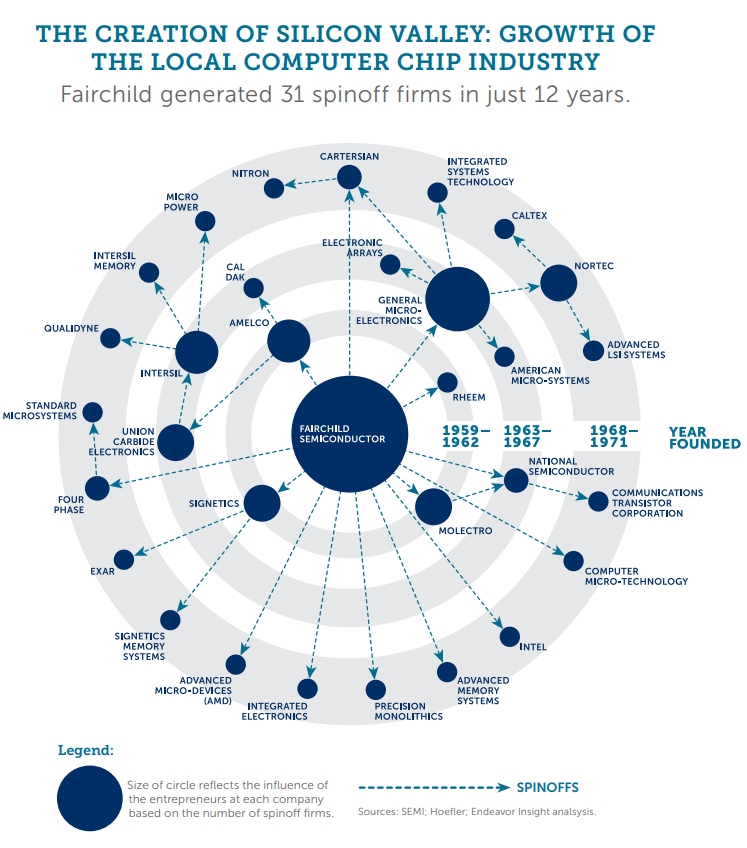
Microchips: Though the invention itself is rightfully credited to Jack Kilby and Robert Noyce, the significant drive of its development came from NASA during the Cold War/Space Race which in turn. The Rockefellers had an investment group called Venrock, which invested in Fairchild semiconductor. The government mandated NASA in the space race to put a person on the Moon, and Fairchild Semiconductor was successful in delivering small-enough transistors for the task. The founding of the Fairchild Semiconductor is its own interesting story involving the traitorous eight, here’s the Wikipedia article.
Eventually, as with all big companies, Fairchild got big and bloated and bureaucratic. This stifled its ability to innovate, led many to quit and in turn generated 31 spinoff firms in 12 years, including Intel, AMD, and NVIDIA.
The Web: Results from efforts for a communication system using different routes (than telephone or land) to communicate between cities in case soviet nuclear bombs hit US cities. It was part of building out decentralised communication avenues
The Database: The relational database was born in IBM research, but it was government-scale data problems in defense, intelligence, and aerospace that helped make large-scale structured data systems economically necessary. Oracle, founded in 1977, was among the first companies to successfully commercialize the relational database model in 1979, bringing it to market as a product category.
The Early Roots of Venture Capital
Venture capital, as we understand it today, emerged gradually from a mix of private wealth, institutional experimentation, and postwar industrial policy. It was less a single invention and more an institutional evolution shaped by wartime innovation and Cold War competition.
Pre-World War II
In the 19th and early 20th centuries, major industrial financiers such as the Vanderbilts, Rockefellers, and Morgans occasionally backed emerging technologies (railroads, oil, steel, electrification). These investments were typically made through family offices or personal networks rather than structured funds, and they functioned more as opportunistic risk capital (light gamble on innovation) than a defined asset class.
Postwar Genesis (1940s–1950s)
Policymakers and financiers tried to replicate wartime innovation in peacetime. (Radar and computing had seen tremendous strides). ARDC (American Research and Development Corporation), founded in 1946 by Georges Doriot, MIT professor and Harvard Business School dean, is often considered the first modern VC firm. ARDC raised money from institutions and individuals to invest in startups commercializing wartime tech. Its big hit: Digital Equipment Corporation (DEC), which turned a $70,000 investment into over $350 million at IPO. The idea of outside investors pooling funds to back small, unproven tech firms was revolutionary.
Venrock
The Rockefeller family created Venrock (short for “Venture Rockefeller”) in 1969 to formalize what the family had been doing informally for decades: investing in new technologies and entrepreneurs. This became one of the first institutionalized family venture funds and played a major role in early Silicon Valley deals (Apple, Intel, etc.). Venrock’s establishment symbolized the moment when old money met the new high-tech economy: a bridge between Gilded Age wealth and modern VC. Back to our main story:
The Berkeley Hippies
All that tension, the changing values, the conflicts, kind of culminated in a rebellion of youth in the SF Bay Area. Peace, not war. Youth marched at Berkeley, riots spread across america (e.g., the Chicago 7), particularly around the Vietnam War. They marched at Stanford, held peace rallies and events. The community of peace shared everything and that spirit of distribution, “information wants to be free”, led to the birth of open source software. Schools changed their policies: Stanford let Professors and Students share and profit on their ideas, they also got rid of weapons research on campus. Counterculture was strong as young people felt alienated by consumerism, conformity, and War politics. That was a particularly strong and centered movement in Northern California - especially the SF Bay. It valued, individual freedom and self-expression, experimentation with consciousness (including through psychedelic drugs like LSD), skepticism toward centralized authority (government, corporations, military).
Liberal Arts Meet Technology
People experimenting with LSD and other psychedelics often described a sense of:
- Expanded perception and creativity
- A belief that technology could be used to liberate rather than control people
- Interest in systems thinking: seeing connections between mind, machine, and universe
These ideas strongly influenced early computer visionaries like:
- Douglas Engelbart (inventor of the mouse and early hypertext concepts)
- Steve Jobs, who openly credited LSD with shaping his sense of creativity and design
- Stewart Brand, publisher of The Whole Earth Catalog, which merged counterculture ideals with early computing culture
The psychedelic-influenced thinkers envisioned computers as tools for individual empowerment, creativity, and community. This in contrast to big military-industrial machine computers of the time. That vision directly inspired:
- The Homebrew Computer Club (where the Apple I was born)
- Early hacker culture at places like Stanford and Berkeley
- The idea that “computers are mind-expanding tools” — a digital extension of the psychedelic quest for consciousness expansion
Well into the 70s now, these movements and ideas inspired music, which inspired entrepreneurs and visionaries. These people, former hippies, embraced change, thought differently than many of their parents. Interracial marriage was illegal in 10+ states in the 60s… That easygoing hippie vibe though “hey man, it’s cool to try, doesn’t matter if you fail,” along with “all ideas are accepted here, be different”
That polarisation in the US made for big clashes out of which came big ideas. And that was unique to the US, particularly around SF Bay. A hotbed of innovative ideas that met with capital equally minded to “give it a shot.” The 60s-70s was the big Silicon Valley Boom. Venture capitalists like Arthur Rock (who helped fund Fairchild and later Intel) became archetypes of the early VC dealmaker. Sand Hill Road in Menlo Park, California, emerged as the symbolic home of venture capital.
A key element finished setting the stage for the modern VC. In 1979, changes to the U.S. Employee Retirement Income Security Act (ERISA), enabled pension fund to invest in VC. This unlocked substantial pools of institutional capital, and along with personal computing and semiconductors, VC became a formal asset class. Kleiner Perkins, Sequoia Capital, and Mayfield emerged and helped scale the model that dominates today.
In the internet space, around PayPal specifically, came many incredible companies. The PayPal “mafia” deserves its own in-depth story, but let’s have an overview for now. In an echo to the hippie movement, the PayPal crowd, but Thiel in particular, did have ideological motivations beyond creating a convenient way to send money online. He’s expressed a skepticism toward centralized government power and traditional financial systems. PayPal’s early vision was a bit more radical than what it became. Thiel and co-founder Max Levchin envisioned a “new world currency” — a kind of digital money that could bypass banks and government controls, allowing people to transact freely across borders. Thiel himself wrote that PayPal could “create a new world currency, free from all government control and political manipulation.” Take away control of monetary policy and take away the most important weapon of governments: the ability to print money. PayPal is also a great case study on network effects, the power of networking in support of good ideas. YouTube, Slide, Clarium, SpaceX, Yelp, and LinkedIn have founders and people tied to PayPal. Sequoia Capital’s biggest deal on YouTube was lead by partner Roelof Botha, former CFO of, you guessed it, PayPal.
Next we will probably discuss launching a new venture and getting that initial funding.